Understanding Waterfront And Canal Homes In Pompano Beach
June 18, 2026
June 18, 2026
You can love the idea of a waterfront home in Pompano Beach and still end up with the wrong fit if you only focus on the view. In this market, two homes can both be called waterfront while offering very different boating access, upkeep needs, and long-term costs. If you are thinking about buying a canal or waterfront property, this guide will help you understand what really matters before you make a move. Let’s dive in.
Pompano Beach is closely tied to life on the water. The city’s coastal canal network connects to the Pompano Canal, Cypress Creek Canal, and the Intracoastal Waterway, and the Intracoastal reaches the Atlantic through Hillsboro Inlet.
That layout is a big reason waterfront homes attract so much attention here. It also explains why location on the water is only the starting point, not the full story.
In Pompano Beach, “ocean access” usually means your boat can leave a private dock, travel through the canal system to the Intracoastal, and then head out to the Atlantic. But that does not mean every route works the same way.
Two homes may both offer ocean access, yet one may have easier turns, wider canal space, and fewer route limitations. The other may technically connect to the same system but be less practical for the type of boat you own or plan to buy.
Some waterfront routes include fixed bridges. These are bridges with limited vertical clearance, which means your boat has to fit under them at normal water levels.
In Pompano Beach, bridge heights are measured from mean high tide. That matters because tidal conditions and your boat’s profile can affect whether a route is comfortably usable or too tight for regular boating.
You do not always need direct water frontage to enjoy a boating lifestyle. Pompano Beach has Water Taxi stops along the Intracoastal, including Sands Harbor Resort and Marina, Dockswell Dock, and Alsdorf Park.
The city also says boat and jet-ski launching is available at Alsdorf Park on NE 14th Street Causeway and the Intracoastal Waterway. For some buyers, a nearby launch or marina can be more practical than owning and maintaining a private dock.
When you compare waterfront and canal homes in Pompano Beach, value comes from more than curb appeal. The dock, route, shoreline condition, flood exposure, and community rules all shape how useful and costly the property may be.
A beautiful backyard on the water can still come with limits that affect your daily experience. That is why it helps to look at each property as both a home and a working waterfront site.
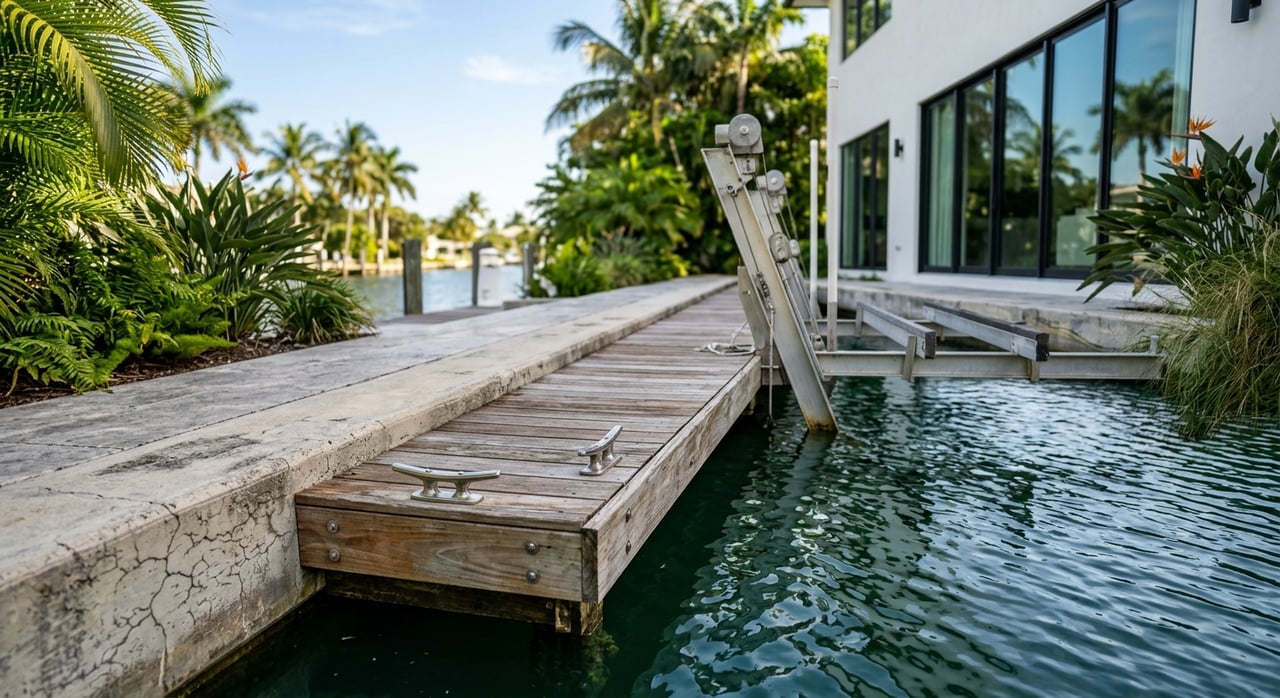
For many buyers, the dock is just as important as the house. Broward County’s dock and seawall permit application asks for details like dock dimensions, number of slips, maximum vessel draft, over-water area, and water-body width.
That tells you something important: vessel fit is not a guess. It is closely tied to site geometry, code limits, and permitting requirements.
In Pompano Beach, city code limits fixed docks and floating docks to 10% of the canal width or 8 feet, whichever is less. Boat lifts are limited to 20% of the canal width or 20 feet, whichever is less, and docks generally may not occupy the 5-foot side setback unless additional conditions are met.
A waterfront home is only as useful as the route from the dock to open water. Even if a listing says ocean access, you still need to know whether the path is practical for your specific boat.
That means looking at bridge clearance, canal turns, and overall route conditions from the dock to the Intracoastal and from the Intracoastal to Hillsboro Inlet. A home that looks perfect on paper may be a poor match if the route is tight or restrictive.
Seawalls are one of the biggest hidden value factors in South Florida waterfront property. A seawall affects shoreline protection, future maintenance, and the cost of upgrades.
In Pompano Beach, installation, replacement, or major repair of a seawall requires a building permit. The city’s checklist calls for engineered drawings, a survey or site plan, a contract or schedule of values, and Broward County environmental resource paperwork.
Broward County also regulates docks and seawalls through aquatic and wetland resources licensing. Even routine shoreline work can become technical quickly, which is why permit history matters so much.
Flood risk is part of owning waterfront property in Pompano Beach. The city says more than 32% of buildings are in a Special Flood Hazard Area, and it also notes that the entire city can be considered flood prone.
The city says coastal properties east of State Road A1A face greater risk from storm surge and waves. It also notes that Pompano Beach participates in the National Flood Insurance Program Community Rating System, which can provide a discount on flood insurance policies.
For buyers, this means flood zone, elevation, and insurance should be reviewed early. Waiting until late in the process can create surprises in both monthly cost and long-term planning.
If you are buying a condo or a home in an HOA, the association can influence your waterfront experience as much as the property itself. Rules may affect marine improvements, renovation flexibility, monthly dues, and future resale.
Florida law requires homeowners’ associations to keep official records such as permits, contracts, warranties, insurance policies, and related documents for at least seven years. Those records must be available for inspection within 10 business days after a proper request.
For condo buyers, required documents can include the declaration, bylaws, rules, financial information, and, when applicable, the milestone inspection summary and the most recent structural integrity reserve study. Reading these early can help you understand carrying costs before you commit.
If you are shopping for a waterfront or canal home in Pompano Beach, a little extra homework can protect both your lifestyle and your budget. These steps can help you ask better questions before you make an offer.
Do not stop at “ocean access” in the listing description. Confirm the route from the dock to the Intracoastal and from the Intracoastal to Hillsboro Inlet, including any fixed bridges or low-clearance spans.
If you own a boat now, or plan to buy one later, verify what the site can actually support. Local code limits dock and lift projections, and county permitting looks closely at vessel draft, slip count, and over-water area.
A repaired or replaced seawall is not automatically a problem, but you want a clear record. Look into permits for seawall work, docks, lifts, and other shoreline improvements so you understand what was done and whether approvals were in place.
Check the flood zone and ask whether an elevation certificate is already on file. The city’s flood information resources may also help identify repeated flood claims, erosion concerns, and local drainage issues.
If the property is in an HOA or condo, request the documents early. On some properties, marine work may also require association approval, especially if the project affects association-owned areas.
A direct-water home is not always the most practical option. In some cases, a non-waterfront home near the Water Taxi, an Intracoastal park, or a public launch may offer easier day-to-day boating use with less maintenance.
Waterfront homes are detail-heavy purchases. The questions are rarely just about bedrooms, square footage, or finishes.
You may also be evaluating route usability, flood exposure, permit history, seawall condition, dock limitations, and association restrictions all at once. That combination can affect whether a property feels right not just on showing day, but years down the road.
A hands-on local team can help you slow the process down in the right places. That kind of support matters when you want clear answers, practical advice, and a smoother path from first tour to closing.
If you are exploring waterfront or canal homes in Pompano Beach and want a calm, honest second opinion, Jason Jardine is here to help you sort through the details and move forward with confidence.
Stay up to date on the latest real estate trends.
Partner with a boutique brokerage that values sincerity, accessibility, and treating your goals as our own.